XERF Treatment vs Facelift: Which Option Is Right for Facial Rejuvenation?
Despite the fact that XERF and facelift surgery are both beneficial in restoring the youthful visage, these procedures have completely different goals.
XERF Treatment vs Facelift: Which Option Is Right for Facial Rejuvenation?
With the ongoing development in aesthetic technology, patients now have plethora of options for facial rejuvenation. These include two treatment modalities frequently discussed at consultations, the XERF AND THE TRADITIONAL FACELIFT. Although both treatments are intended to rejuvenate a more youthful appearance, they greatly differ in their method, recovery time and the degree of result achieved.
Knowing how these treatments differ can help patients decide which one aligns with their goals, lifestyle and comfort level.
What Is XERF Treatment?
XERF is a noninvasive skin tightening procedure that utilizes RF energy to promote collagen production under the skin. The treatment involves controlled heat being passed through to the deeper layers of tissue, activating the body’s natural healing response and stimulating new collagen and elastin production.
Collagen Is the structural protein that keeps the skin firm and stop sagging With age, collagen production dwindles, resulting in deflation and laxity of skin including sagging, wrinkles, and loss of contouring in the jawline and cheeks.
XERF helps to counteract this process by contracting existing collagen fibers while stimulating the synthesis of new ones, producing gradually firmer and smoother skin.
Common areas treated with XERF
- Jawline and lower face
- Cheeks
- Neck
- Around the mouth (nasolabial folds)
- Mild skin laxity in the midface
XERF, being non-invasive in nature, is preferred by the patients to avoid surgical procedures and cessation of their daily routine.
What Is a Facelift?
A facelift (rhytidectomy, in medical terms) is an invasive surgical procedure that aims to "elevate" and relocate facial tissue to reduce moderate to severe sagging. In a facelift, a surgeon makes strategically placed incisions (typically around the ears and hairline), then lifts underlying tissues and removes excess skin.
This is a procedure that goes deeper than just treating surface aging and non-surgical methods cannot fully resolve.
A facelift typically improves:
- Deep wrinkles and folds
- Significant skin sagging
- Jowls along the jawline
- Loose skin in the neck
- Loss of facial contour
-
Since it physically re-arranges tissue, a facelift yields more significant and longer-lasting results than non-surgical options.
No, XERF is not a new name for facelift
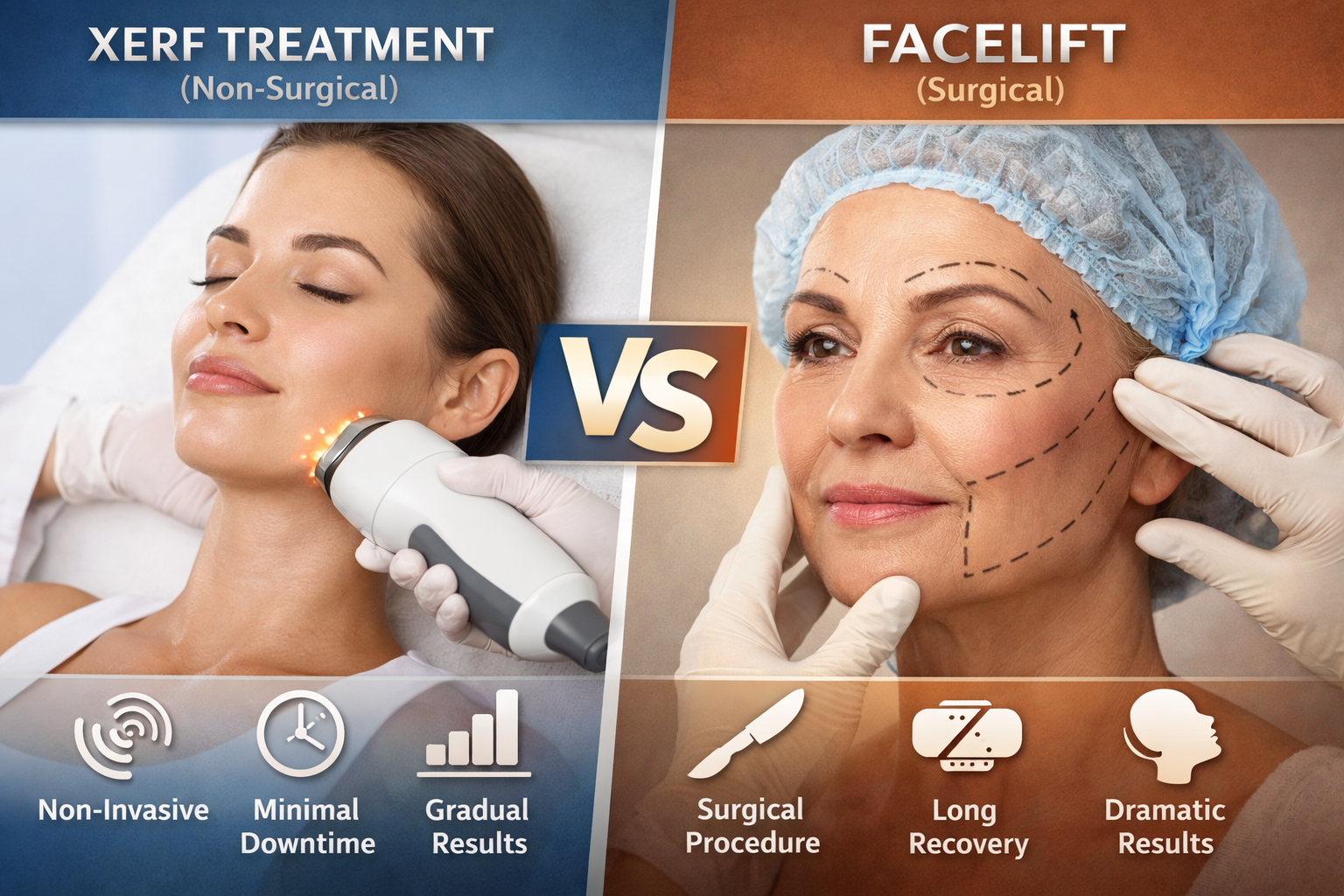
Surgical vs Non-Surgical
XERF is also non-surgical, while a facelift is a surgical procedure that requires anesthesia and incisions.
Patients want minimal intervention may opt for XERF, patients who need more transformative effects will benefit from facelift.
Downtime and Recovery
Recovery time is one of the best benefits of XERF. For the majority of patients, normal activity was resumed immediately after treatment.
Facelift surgery, by contrast, typically takes 1–3 weeks to recover from and comes with swelling and bruising.
Degree of Results
XERF delivers gradual tightening and tissue quality enhancement that is best suited for those with mild to moderate skin laxity.
A facelift provides more structural elevation, better for moderate to advanced signs of aging.
Longevity of Results
Because XERF stimulates collagen, results take months to develop and usually last 1–2 years with maintenance treatments.
A facelift can last 7–10 years, though this depends on the individual's lifestyle and level of skin quality.
Cost
All non-surgical therapies including XERF, are much cheaper than surgery. Facelifts involve operating rooms, anesthesia and surgical skill, so overall, they’re more expensive.
Who Is an Ideal Candidate for XERF?
XERF is most appropriate for patients with:
- Have mild to moderate skin laxity
- Looking to get rid of early signs of aging
- Prefer non-surgical treatments
- Want little to no downtime
- Are looking for gradual, natural improvements
XERF is often chosen by patients in their 30s to early 50s as a preventative or initial correction intervention.
Who Is an Ideal Candidate for a Facelift?
For such patients, a facelift might be the better choice for these reasons:
- Have significant sagging or jowls
- Look for sagging skin in the neck and jaw area
- Want dramatic and long-lasting results
- Are comfortable with surgery and recovery time
People in their 50s and older get most of the benefit from facelift surgery, but age isn’t the only factor.
Can XERF Replace a Facelift?
In some patients, XERF can put off a facelift indefinitely, but when there is already substantial skin laxity it will not be a substitute for surgical lifting.
XERF can really help if you want to maintain results after your surgery or improve skin quality before even thinking about going under the surgeon's knife.
To achieve optimal long-term outcomes, non-surgical collagen stimulation treatments are often integrated into aesthetic treatment plans used alongside surgical procedures.
Frequently Asked Questions About Xerf vs. Facelift (FAQs)
What is it like to receive XERF treatment?
Most patients note the procedure feels like a warm sensation on their skin as radiofrequency energy is administered. The treatments are generally well tolerated and do not require great or any numbing.
How long does a XERF Treatment take?
Sessions typically last 30–60 minutes depending on what areas are being treated.
How long before I see the results of XERF?
You may experience some mild tightening immediately following treatment, but results are most noticeable over 8–12 weeks as collagen production is ramped up.
With the skin types in mind, is XERF a safe option?
Yes. And the radiofrequency energy targets tissue below the skin, as opposed to pigment, so XERF is safe for nearly all skin colors and types.
How many more XERF treatments will be required?
Most patients experience improvement after one treatment, but some providers recommend a full series for best results based on the site’s level of laxity.
How long does it take for XERF results to wear off?
Results can be long-lasting (1–2 years); maintaining treatments may prolong effects;
How long is the recovery period for a facelift?
Most patients need two weeks of downtime, although swelling may take a few weeks to ever completely resolve.
Does a facelift look natural?
Although a facelift is one of the most recognized signs of cosmetic surgery, modern techniques target deeper tissues rather than merely pulling on skin and when performed by skilled hands render natural-looking results.
May XERF be given with other therapies?
Yes. – XERF is frequently combined with treatments such as lasers, fillers or microneedling to improve skin overall quality and enhance results.
How can I determine which treatment is appropriate for me?
Consultation by a qualified aesthetic provider, who can examine how your skin and facial structure play together with the results you would like to achieve, is the best way to determine what options are suitable for you.
They can advise whether a non-surgical option such as XERF will meet your goals or, if you need more permanent solution, a surgical approach like a facelift might be the best long-lasting solution.
Despite the fact that XERF and facelift surgery are both beneficial in restoring the youthful look, these procedures have completely different goals. Patients with early stages of aging, or those who are looking for procedures that require minimal downtime and want something to help tighten their skin naturally will love XERF.
A facelift, however, is still the gold standard for addressing pronounced facial sagging and providing dramatic, long-last results.
In today’s aesthetic landscape, countless options are available to patients looking to achieve their desired results at a speed and caliber that best suits them as well as their unique timeline and comfort level through customized plans that produce natural yet long-term rejuvenation.
Read More Blogs!
Stay updated with the latest blog posts and engage with our community.